
Executive Summary: The Death of Tactical Marketing
As a Digital Marketing Strategist in 2026, you are operating in a world where the barrier to content creation has vanished. With generative AI capable of producing high-fidelity assets in seconds, the market is saturated with “good enough” content. For the brand leader, this presents a paradox: Visibility is higher than ever, yet trust is at an all-time low.
The solution for the modern Digital Marketing Strategist is not more automation—it is Strategic Orchestration. This insight outlines how to move beyond the algorithm to reclaim brand authority through human-centric data and emotional resonance.: Visibility is higher than ever, yet trust is at an all-time low. The solution is not more automation—it is Strategic Orchestration. This insight outlines how the modern strategist moves beyond the algorithm to reclaim brand authority through human-centric data and emotional resonance.
I. The Shift from Execution to Architecture
For a decade, digital marketing was defined by execution: SEO keyword stuffing, manual A/B testing, and social media scheduling. Today, these are “utility” tasks handled by autonomous agents.
The New Role of the Strategist
As a strategist in 2026, your value lies in Architecture. You are the one who designs the ecosystem in which the AI operates. This involves:
- Objective Alignment: Ensuring AI tools are chasing Profit Equity rather than just Engagement Vanity.
- Ethical Oversight: Navigating the complex landscape of AI bias and data privacy.
- Creative Direction: Providing the “Human Spark” that AI cannot synthesize—genuine lived experience.
Strategist’s Note: AI can predict what a customer might do based on past data, but it cannot predict how a cultural shift will change what a customer feels. That is where the strategist wins.
II. The 2026 SEO Pivot: From Keywords to Intent & Entity
Search engines have evolved into Generative Answer Engines. Traditional keyword density is dead. To rank in 2026, your strategy must focus on EEAT (Experience, Expertise, Authoritativeness, and Trustworthiness) at a technical level.
1. Semantic Wealth
Instead of targeting “Digital Marketing Strategy,” we target the Entity. We build a web of related concepts (Data Privacy, Predictive Analytics, Consumer Psychology) that proves to the algorithm that this site is a topical authority.
2. The Rise of “Zero-Click” Optimization
Optimizing for the “Snippet” or the “AI Summary” is the goal. We do this by using structured data (Schema.org) to tell the AI exactly what our conclusion is.
- Actionable Step: Every insight must contain a “Key Takeaways” block formatted specifically for LLM ingestion.
III. Data Sovereignty: The Zero-Party Data Revolution
With the final sunsetting of third-party cookies and the tightening of global privacy laws (GDPR 2.0), the strategist’s most powerful weapon is Zero-Party Data.
What is Zero-Party Data?
It is data the customer intentionally and proactively shares with you.
- Strategy: Use interactive quizzes, preference centers, and value-exchange tools to learn about your audience.
- The Global Impact: Brands that ask for permission rather than tracking by stealth are seeing a 40% higher conversion rate in European and North American markets.
IV. The Synergy Framework: How to Lead the Machine
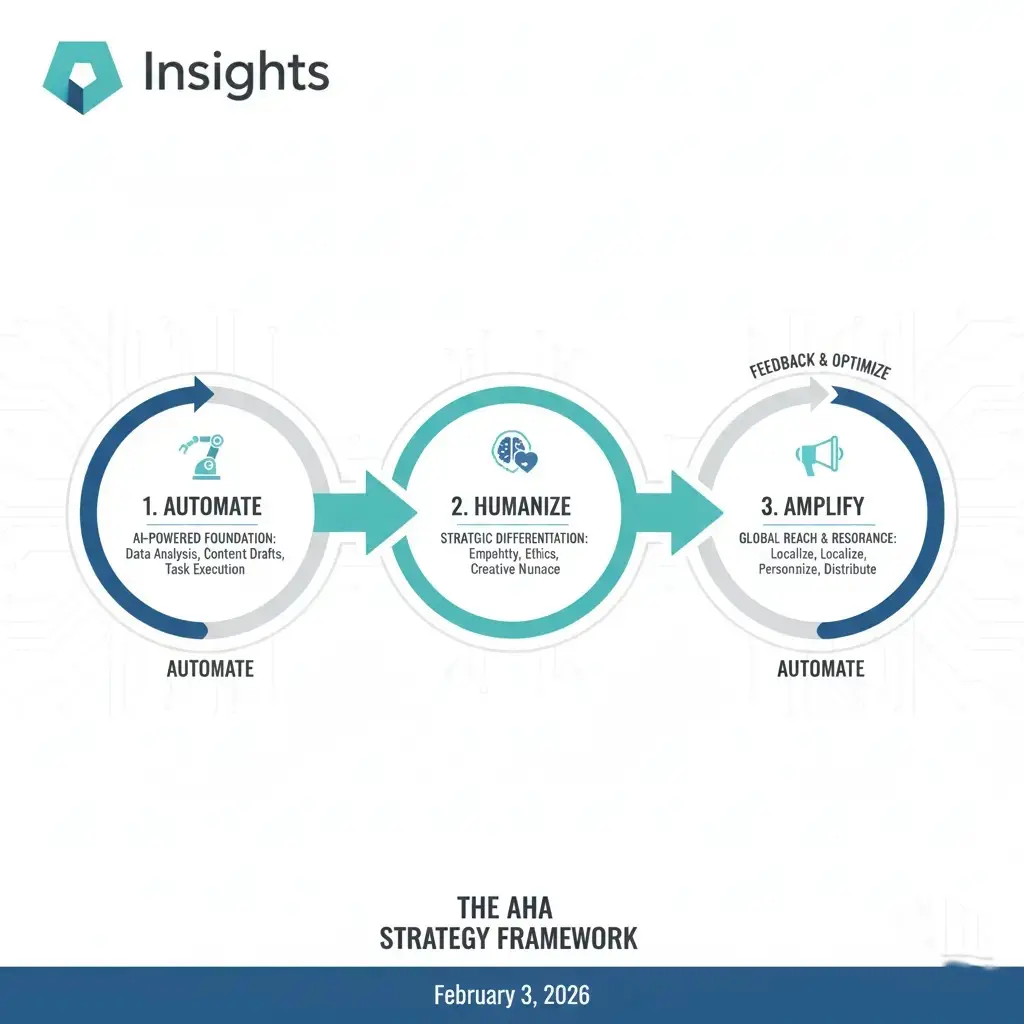
To achieve global acceptance, a strategy must be scalable yet personal. We use the A.H.A. Framework (Automate, Humanize, Amplify).
1. Automate (The Foundation)
- Use AI for the heavy lifting:
- Data cleaning and pattern recognition.
- Initial draft generation for technical documentation.
- Real-time bid adjustments in programmatic advertising.
2. Humanize (The Differentiator)
This is where the strategist enters. We inject:
- Nuance: Does this content sound like our brand, or does it sound like a generic robot?
- Ethics: Is this campaign inclusive and transparent?
- Empathy: Does this solve a real human pain point, or is it just noise?
3. Amplify (The Reach)
Once the “Human-Approved” strategy is ready, we use AI to create 50 variations for different global markets—adjusting for cultural idioms, local languages, and regional buying habits.
V. Navigating Global Markets in 2026
Digital marketing is no longer “one size fits all.” A strategist must understand regional nuances:
- APAC Region: Heavy focus on Super-App integration and “Live-Stream” commerce strategy.
- EMEA Region: Prioritizing data sovereignty and “Sustainability-as-a-Service” messaging.
- Americas: Focusing on hyper-personalization and frictionless “One-Click” ecosystems.
VI. Measuring What Matters: New KPIs
We have moved beyond the “Click-Through Rate” (CTR). In 2026, the strategist tracks:
- Sentiment Velocity: How quickly is the public perception of the brand moving in a positive direction?
- Conversion Integrity: The percentage of leads that stay loyal for more than 12 months (Retention over Acquisition).
- AI Share of Voice: How often is your brand cited as the “Source of Truth” by generative search engines?
VII. Conclusion: The Future belongs to the Architects
The era of the “Generalist Marketer” is over. The era of the Digital Marketing Strategist has arrived. By embracing AI as a co-pilot rather than a replacement, and by doubling down on human empathy and complex data architecture, you don’t just survive the algorithmic shifts—you dictate them.
The machine provides the speed; the strategist provides the direction.
VIII. Frequently Asked Questions (The GEO Block)
Q: How do I justify a high-level strategy budget when AI tools are cheap?
A: AI is a commodity; strategy is a competitive advantage. Cheap tools produce average results. A strategist ensures that the AI’s output aligns with high-level business goals and ROI, preventing wasted spend on “noisy” content.
Q: Is “Human-Centric” marketing just a buzzword?
A: No. In a world of 90% AI content, “Human-Centric” is a technical requirement for trust. Brands that lack a human touch are being penalized by both users (lower engagement) and algorithms (lower trust scores).
Q: What is the first step in transitioning to a 2026 strategy?
A: Conduct a “Brand Authority Audit.” Identify where you are relying too heavily on automated templates and where your unique “Brand Voice” has been lost.