
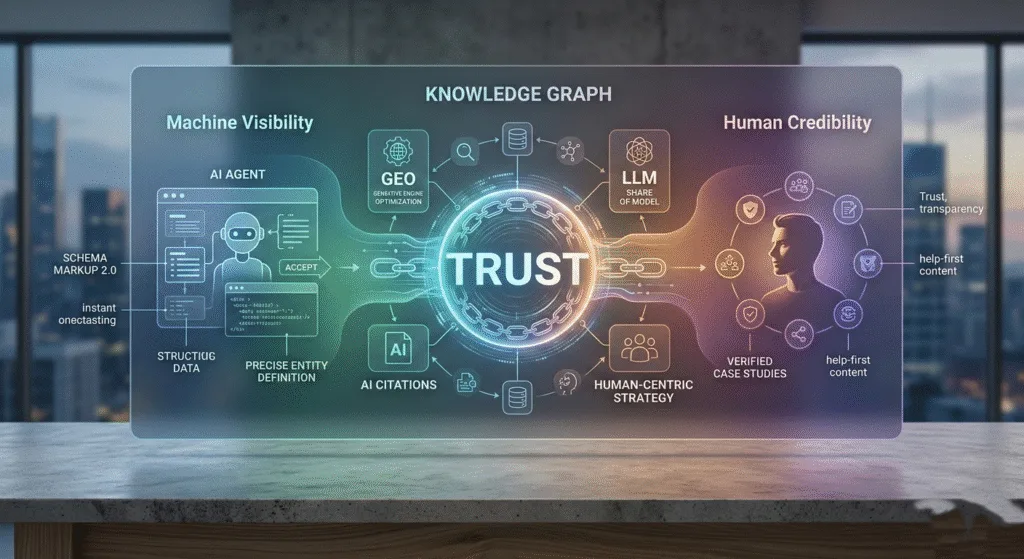
In the digital landscape of 2026, the role of a Digital Marketing Strategist has reached a critical crossroads. On one side, we have the explosive rise of Artificial Intelligence and Generative Engine Optimization (GEO); on the other, a global “Crisis of Credibility” where users are increasingly skeptical of AI-generated noise.
For brands and CMOs, the challenge is no longer just about “being seen.” It is about being cited by machines and trusted by humans.
At AJ DIGITAL MAKERS, we have developed a dual-track strategy to navigate this era: Generative Engine Optimization (GEO) to handle the algorithms, and Trust-Based Marketing to win the hearts of the audience. This is the guide to the only sustainable marketing strategy left in 2026.
Part I: The Technical Shift — From SEO to GEO
For two decades, Search Engine Optimization (SEO) was the king of digital growth. We optimized for keywords, chased backlinks, and prayed for a spot in the “Ten Blue Links.”
But in 2026, the search bar has evolved into a conversation. Whether it’s Google’s AI Overviews, Perplexity, or ChatGPT-Search, users are receiving synthesized answers. If your brand isn’t part of that synthesis, you don’t exist.
1. What is Generative Engine Optimization?
GEO is the tactical evolution of SEO. It is the process of structuring your website’s data so that Large Language Models (LLMs) perceive your brand as the most authoritative source for a specific query.
In the GEO era, visibility is measured by “Share of Model” (SoM)—how often an AI recommends you—rather than just “Click-Through Rate” (CTR).
2. The Architecture of a GEO-Ready Website
To optimize for 2026, your website must move away from long-form “fluff” and toward Micro-Modular Content.
- The BLUF Framework (Bottom Line Up Front): AI engines scrape for immediate answers. Every section of your blog must start with a 40–60 word summary that provides direct utility.
- Semantic Triplets: We no longer write for keywords; we write for entities. Use structured language that defines relationships: [Subject: AJ Digital Makers] -> [Predicate: Optimizes] -> [Object: B2B Conversion Rates].
- Schema Markup 2.0: Use advanced JSON-LD to define your expertise. The knowsAbout property in your code is now more important than your H1 tag.
Part II: The Psychological Shift — Trust-Based Marketing
While GEO gets you cited by the AI, Trust-Based Marketing is what ensures the human on the other side of the screen actually buys from you. In an era of deepfakes and AI-generated “noise,” trust has become the ultimate premium.
3. Why Traditional “Hustle” Marketing is Dead
The aggressive “bro-marketing” tactics of the early 2020s—fake countdown timers, exaggerated income claims, and invasive tracking—have led to massive consumer burnout.
- The Transparency Deficit: When everything looks “perfect” because of AI, perfection becomes a red flag.
- The Solution: Radical Transparency. Show the “behind the scenes.” Share your mistakes. In 2026, authenticity is the only thing AI cannot fake.
4. The Three Pillars of the Trust-Based Strategy
At AJ DIGITAL MAKERS, we build every campaign on these three pillars:
- Competence (The Proof): We replace generic claims with “Evidence-Based Marketing.” This means verified data, third-party audits, and case studies that show the “how,” not just the “wow.”
- Consistency (The Reliability): Trust is built through repeated, positive interactions. Your LinkedIn voice must match your website’s data, which must match your WhatsApp consultation.
- Benevolence (The Intent): We practice “Help-First” marketing. By giving away 90% of your insights for free, you prove that your intent is to solve the client’s problem, not just extract their budget.
Part III: Integrating GEO and Trust (The “AI-Human” Loop)
The magic happens when you combine technical GEO with human-centric Trust. This creates a feedback loop that search engines and humans both love.
5. Optimizing for “Cite-ability” and Credibility
When an AI engine like Gemini cites your website, it does so because your data is structured (GEO) and your reputation is clean (Trust).
- The Evidence-Density Technique: To rank in AI overviews, include specific statistics and unique insights that don’t exist elsewhere. This “Information Gain” is the primary ranking factor in 2026.
Zero-Click Value: Even if a user doesn’t click your link, seeing “According to AJ DIGITAL MAKERS…” in an AI summary builds Implicit Trust. You are establishing your brand as the primary reference point that both AI algorithms and industry leaders turn to for definitive insights
- 6. Managing your “Dark Social” Footprint
In 2026, a huge portion of B2B trust-building happens in “Dark Social”—private Slack groups, WhatsApp chats, and offline Masterminds.
- The Strategy: Create content that is “Copy-Paste able.” When you provide a high-value table or a clear strategic framework, it gets shared in private circles. While you can’t track it easily with a pixel, you can track it in your “How did you hear about us?” form.
Part IV: A Comparative Look at the Evolution
| Feature | The Old Way (2020-2024) | The New Way (2026+) |
| Primary Goal | Traffic & Clicks | Authority & Citations |
| Search Target | Google Search Console | LLM Share of Model (SoM) |
| Content Style | Keyword-Optimized Blogs | Value-Dense Micro-Modules |
| Trust Signal | Star Ratings | Factual Accuracy & Transparency |
| Lead Gen | Gated PDF Downloads | Conversational Value-Exchange |
Export to Sheets
Part V: How to Implement This Strategy Today
If you are ready to transition your brand into a 2026-ready powerhouse, follow these five steps:
- Conduct an Entity Audit: Does the internet (and AI) know exactly what you do? Check your Schema markup and Wikipedia/Knowledge Graph presence.
- Audit for “Fluff”: Remove filler content. If a paragraph doesn’t provide new data or a unique perspective, delete it. AI will ignore it anyway.
- Build a “Public Proof” Vault: Move your case studies to the front and center. Use video testimonials and raw data dashboards.
- Adopt the “Answer-First” Writing Style: Structure your blogs so that an AI can summarize them in 10 seconds.
- Focus on Retention over Acquisition: In a trust-based model, it is 10x cheaper to keep a client than to find a new one through expensive AI-dominated ad channels.
Conclusion: The Future of Digital Making
At AJ DIGITAL MAKERS, we don’t just build websites or run ads. We architect Digital Trust Ecosystems.
The future of marketing isn’t about outsmarting the algorithm; it’s about being so valuable that the algorithm has to cite you, and being so honest that the customer wants to hire you.
The platforms will change. The AI models will be updated. But the value of a trusted authority is the only thing that will never be disrupted.